
"Organic Guard" text on green background

Compostable tree mulch for arboriculture, reforestation and perennial crops.
Including blueberries, strawberries and raspberries.

FilmOrganic compostable mulch systems are used for tree planting, perennial beds, and urban landscaping projects where long-term establishment is required without leaving plastic residues in the soil.

Designed for trees, perennials, and long-term plantings, FilmOrganic systems support establishment …without polyethylene, plastic removal, or long-term microplastic contamination of soils.

Compostable Mulch & Tree Protection Designed for Arboriculture

Request pricing & system recommendation

Compostable tree mulch for arboriculture and reforestation

  • Agricultural coulees (tree establishment)

  • Windbreak / Shelterbelt (tree planting systems)

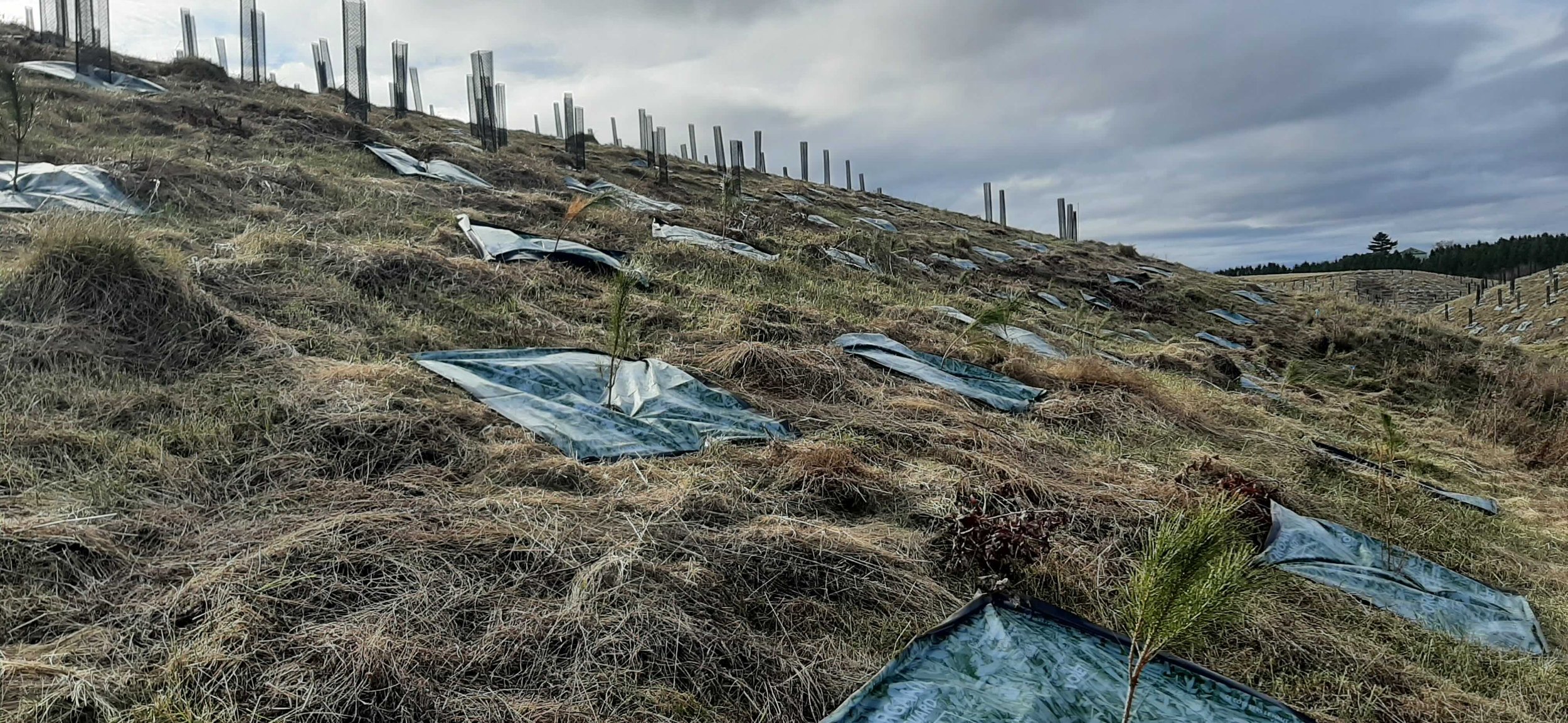
  • Reforestation (plastic-free reforestation mulch)

  • Landscaping (urban tree & perennial planting)

  • Orchard (biodegradable orchard mulch)

Agricultural coulees (tree establishment)

Agricultural coulees

Windbreak / Shelterbelt (tree planting systems)

Windbreak Shelterbelt

Reforestation (plastic-free reforestation mulch)

Reforestation

Landscaping (urban tree & perennial planting)

Landscaping

Orchard (biodegradable orchard mulch)

Orchard

Biodegradable tree protection without plastic legacy

OrganicGUARD is designed to perform in the same conditions where polyethylene is traditionally used — exposed sites, hardwood plantations, reforestation projects and low-maintenance installations.

Field performance

  • Reliable weed suppression during the critical establishment phase

  • Thermal insulation that moderates soil temperature

  • Moisture retention that reduces water stress

  • Improved survival rates, particularly for young hardwood trees

Operational benefits

  • No plastic removal at the end of the project

  • No collection, transport or disposal of contaminated plastic

  • Reduced long-term maintenance burden

  • Simplified project close-out

Environmental integrity

  • No polyethylene

  • No PFAS

  • No microplastics

  • Full biodegradation in soil after the protection phase

OrganicGUARD allows professionals to meet performance requirements without creating a long-term soil legacy.

Applications: trees, perennials, and urban planting

Available formats & quantities

OrganicGUARD is available in formats commonly used in professional arboriculture, reforestation and urban forestry projects.

Systems available

  • 3-year system — for standard establishment periods

  • 5-year system — for challenging sites or slow-growing species

Formats

  • Rolls

  • Collars

Quantities and anchoring recommendations are adjusted based on:

  • project type

  • soil conditions

  • exposure (wind, slope)

  • required lifespan

All systems are validated with you before quoting to ensure proper field performance.

Comparison table showing specifications of collars and rolls over 3 and 5 years. Includes surface area measurements, quantity sold in packs, boxes, and pallets.

Compostable vs polyethylene tree mulchPolyethylene is used because it works

In arboriculture and reforestation, polyethylene is widely used for one simple reason:
it delivers reliable results.

It provides effective weed control, thermal insulation and moisture retention —
critical factors for tree survival, especially for hardwood species and low-maintenance projects.

In many real-world situations, removing polyethylene without a proven alternative would directly compromise survival rates.
This reality is well understood by professionals in the field.

The real issue is not performance — it is end of life

Polyethylene does not biodegrade.

Over time, it fragments under UV exposure, mechanical stress and temperature variations, creating microplastics that remain permanently in the soil.

These microplastics are:

  • invisible

  • impossible to remove

  • persistent for decades

This is not a question of efficiency during the project —
it is a long-term soil liability.

A necessary clarification on “degradable” plastics

Some materials marketed as degradable or oxo-degradable are still based on polyethylene.

They may fragment faster,
but fragmentation is not biodegradation.

Breaking plastic into smaller pieces does not make it disappear —
it only spreads it further into the soil.

How OrganicGUARD is fundamentally different

OrganicGUARD was designed to deliver the same peace of mind as polyethylene,
without the polyethylene end-of-life problem.

Like all biodegradable materials, OrganicGUARD undergoes controlled fragmentation as part of the biodegradation process.

The critical difference is what this fragmentation produces.

Polyethylene does not biodegrade.
Over time, it fragments under UV exposure, mechanical stress, and temperature variations, creating microplastics that persist permanently in the soil.

OrganicGUARD fragments into biodegradable components that are fully metabolized by soil microorganisms, transforming into:

  • water

  • CO₂

  • biomass

Without leaving microplastics behind.

The functional benefits professionals expect remain the same:

  • reliable weed suppression

  • soil insulation

  • moisture conservation

  • improved tree survival

The difference is what remains after the job is done.

The protection disappears — not the problem.

Key takeaway for professionals

Polyethylene is used because it guarantees results.
OrganicGUARD was engineered to provide the same level of reliability,
while eliminating the long-term presence of plastic in the soil.

Benefits & performance in real-world arboriculture projects

Infographic showing benefits of tree growth. Features an illustration of a young tree with roots. Text highlights benefits: accelerates growth, blocks weeds, acts as an insulator by warming air and soil, and generates nitrates as fertilizer."}

FEATURES :

  • Biodegradable tree protection

  • Biodegradable membranes made from corn, bioplastics and minerals.

  • Contain no polyethylene or pollutants.

  • Eliminate the use of pesticides.

  • Does not create microplastics.

  • Does not contain PFAS.

  • Available in collars and rolls.

  • Yes. Compostable tree mulch is designed for tree planting, arboriculture, reforestation, and long-term establishment projects where reliable performance is required during the critical establishment phase.

    OrganicGUARD provides the same functional benefits professionals expect from polyethylene mulch — weed suppression, soil insulation, and moisture retention — without creating a permanent plastic residue in the soil.

    It is used in commercial, municipal, and reforestation projects where both field performance and long-term soil integrity are important.

    Every project is different.
    If you would like us to review your specific application, we want to hear about your project.
    📩 
    Write to us at info@filmorganic.com

  • Yes. Compostable mulch can be used for perennial crops such as blueberries, where weed control and moisture conservation are critical, particularly during establishment.

    In blueberry systems, OrganicGUARD helps:

    • control weeds along the row

    • reduce soil moisture fluctuations

    • moderate soil temperature

    System selection (lifespan, format, anchoring) is adapted based on planting layout, site conditions, and expected lifespan of the planting.

    To ensure proper performance, system selection matters.
    We want to understand your planting system and site conditions.
    📩 
    Write to us at info@filmorganic.com

  • Yes. Compostable mulch can be used for perennial fruit crops such as strawberries and raspberries, where weed control, soil moisture management, and temperature moderation are important.

    During the establishment and early production years, OrganicGUARD provides consistent protection while eliminating the need for plastic removal at the end of the cycle.

    System selection is adjusted based on:

    • crop type

    • planting method

    • expected duration of use

    Choosing the right system is key.
    Tell us about your project so we can recommend the appropriate solution.
    📩 
    Write to us at info@filmorganic.com

    l’élément

  • No.

    OrganicGUARD does not contain polyethylene and does not generate microplastics.

    While polyethylene fragments into persistent microplastics that remain in the soil for decades, OrganicGUARD undergoes controlled fragmentation as part of the biodegradation process and is fully metabolized by soil microorganisms.

    It biodegrades into:

    • water

    • CO₂

    • biomass

    No plastic residue remains in the soil.

  • The lifespan of compostable tree mulch is engineered, not accidental.

    OrganicGUARD is available in systems designed to provide:

    • 3 years of effective protection for standard establishment projects

    • 5 years for more demanding sites or low-maintenance conditions

    The mulch remains functional throughout the critical establishment phase and biodegrades after its protective role is complete.

  • Yes — when the system is properly specified.

    Polyethylene has traditionally been used for weed control and moisture conservation in reforestation. OrganicGUARD was developed to deliver equivalent field performance during establishment.

    The key difference is end of life.

    Polyethylene fragments into microplastics that remain in the soil indefinitely.
    OrganicGUARD eliminates this long-term soil liability by fully biodegrading in place.

  • Yes.

    OrganicGUARD is increasingly used in municipal, urban forestry, and public landscaping projects where plastic removal, disposal costs, and long-term soil contamination are major concerns.

    Because it:

    • requires no end-of-project plastic removal

    • reduces handling and disposal of contaminated plastic

    • leaves no microplastic legacy

    OrganicGUARD aligns with public sustainability objectives without compromising field performance.

    As with any municipal or public project, eligibility and acceptance must be validated with the relevant authority.
    Project requirements, specifications, and approval processes may vary by municipality or jurisdiction.

    We are open to collaboration.
    Share your project with us at 
    info@filmorganic.com

  • IYes — when considered per unit, compostable tree mulch typically has a higher upfront cost than polyethylene.

    However, unit price alone does not reflect the true cost of polyethylene in arboriculture and long-term planting projects.

    Polyethylene does not biodegrade.
    It persists in the soil indefinitely, fragmenting over time into microplastics that cannot be recovered.

    In tree and perennial systems, polyethylene gradually becomes buried in the soil as roots develop, soil settles, and maintenance operations continue.
    After several years, removal is no longer practical — and often no longer possible.

    If polyethylene had to be removed after five years in tree planting projects, the labor, soil disturbance, and disposal challenges would be significant.

    Compostable tree mulch eliminates this long-term liability entirely.
    It performs its function during establishment, then biodegrades in place — 
    without removal, without disposal, and without leaving plastic residues behind.

    The real comparison is not unit price.
    It is 
    short-term cost versus long-term soil responsibility.

Learn more (optional details)

“Why professionals still use polyethylene — and what changes with OrganicGUARD”

  • microplastics / end-of-life / same peace of mind

Request pricing & system recommendation

2 types of products available, lifespan 3 or 5 year.

Three organic, biodegradable membrane bags with a green shredded texture and text labeling, including 'Organic Guard' and 'FILMORGANIC.'

60 cm x 60 cm & 1m2 collar, with practical cut-out

Plowed field with plastic mulch under blue sky and scattered clouds

1000' roll, disk with a conventional machine

Installation & end-of-life guidelines